Learning French can dramatically boost CRS score French and open doors to Canadian permanent residency through Express Entry. This guide is for Express Entry candidates who want to increase Express Entry points by adding French as their second official language.
Many PR hopefuls don’t realize that French proficiency can add up to 50 points to their CRS score – often making the difference between receiving an invitation and waiting indefinitely. Adding French language CRS points to your profile creates multiple pathways to reach competitive scores above 470-480 points.
We’ll walk you through the TEF Canada and other accepted French tests that IRCC recognizes for points. You’ll discover strategic score targets that maximize your point gains without wasting time on unnecessarily high levels. Finally, we’ll share practical learning methods that help busy professionals prepare for their Canada PR French test while balancing work and family commitments.
Whether you’re starting from zero or brushing up rusty French skills, this roadmap will help you turn language learning into your Express Entry advantage.
Understanding CRS Points and Language Requirements

Breakdown of CRS scoring system for language skills
The Comprehensive Ranking System (CRS) awards significant points for language proficiency, making it one of the most impactful factors in your Express Entry application. Language skills can earn you up to 260 points out of the total 1,200 CRS points available. These points are divided into two main categories: core human capital factors (136 points maximum) and skill transferability factors (124 points maximum).
For your first official language, you can earn up to 136 points across four abilities: listening, reading, writing, and speaking. Each skill is worth 34 points maximum, based on Canadian Language Benchmarks (CLB) levels 4 through 10. Here’s how the points break down:
| CLB Level | Points per Skill | Total for All 4 Skills |
|---|---|---|
| CLB 10 | 34 | 136 |
| CLB 9 | 31 | 124 |
| CLB 8 | 23 | 92 |
| CLB 7 | 17 | 68 |
| CLB 4-6 | 6 | 24 |
The skill transferability section offers additional points when you combine strong language skills with other factors like education or work experience. You can earn up to 50 extra points when your first official language reaches CLB 9 or higher in all four skills, combined with a post-secondary degree or skilled work experience.
How French as second official language impacts your score
Adding French language proficiency to your profile can dramatically boost CRS score French learners enjoy. When you demonstrate intermediate or advanced French skills, you unlock bonus points that many other candidates miss entirely. The second official language category specifically rewards French proficiency, as it’s Canada’s other official language alongside English.
French proficiency impacts your score in two distinct ways. First, you earn direct points for your French language abilities in the second official language section. Second, you may qualify for additional skill transferability points that combine your French skills with other credentials.
The beauty of focusing on French lies in the competitive advantage it provides. While most Express Entry candidates focus solely on improving their English scores, those who increase Express Entry points through French often find themselves in a much stronger position. This strategy becomes particularly valuable when CRS cut-off scores remain high, and every additional point counts toward receiving an Invitation to Apply (ITA).
Canada actively encourages French-speaking immigration through various programs and initiatives. The government recognizes the importance of maintaining the country’s bilingual character, especially outside Quebec. This policy direction translates into meaningful point allocations for candidates who invest time in developing French language skills.
Point allocation differences between English and French proficiency
The CRS system treats your first and second official languages differently, creating unique opportunities for strategic planning. Your first official language (typically English for most candidates) follows the detailed point structure outlined earlier, with maximum points available at higher proficiency levels.
For French as your second official language, the system awards points based on achieving minimum thresholds rather than incremental improvements. You need to reach at least CLB 5 in all four French language skills to start earning points. Here’s the French language CRS points breakdown:
- CLB 5-6 in all four skills: 1 point
- CLB 7-8 in all four skills: 3 points
- CLB 9-10 in all four skills: 6 points
While these numbers might seem modest compared to first language points, they represent bonus points added to your existing score. Many candidates overlook this opportunity, focusing exclusively on maximizing their English proficiency instead of diversifying their language portfolio.
The point allocation system also creates interesting strategic decisions. Improving your English from CLB 8 to CLB 9 requires significant effort but yields substantial point increases. Meanwhile, achieving CLB 7 in French requires less overall proficiency but still provides valuable bonus points that could make the difference in receiving an ITA.
Maximum points achievable through bilingual proficiency
Bilingual candidates can achieve remarkable CRS scores by maximizing both official language proficiencies. The theoretical maximum from language skills alone reaches 260 points: 136 from your first official language, 6 from French proficiency, and up to 118 additional points through skill transferability combinations.
The skill transferability section becomes particularly powerful for bilingual candidates. You can earn up to 50 points for combining CLB 9+ in your first language with post-secondary education, plus another 50 points for combining the same language level with skilled work experience. Additional combinations involving French proficiency can push your skill transferability points even higher.
Smart candidates often target specific French language CRS points thresholds that align with their overall profile. For example, reaching CLB 7 in French (3 bonus points) might be more achievable and cost-effective than pushing English skills from CLB 9 to CLB 10. The key lies in understanding how different combinations of language scores, education, and work experience create the most efficient path to your target CRS score.
Consider this realistic scenario: A candidate with CLB 9 English, CLB 7 French, a master’s degree, and three years of skilled work experience could achieve over 470 CRS points. This puts them in an excellent position for most Express Entry draws, demonstrating how French proficiency serves as a powerful differentiator in competitive immigration pools.
French Language Proficiency Tests Accepted by IRCC
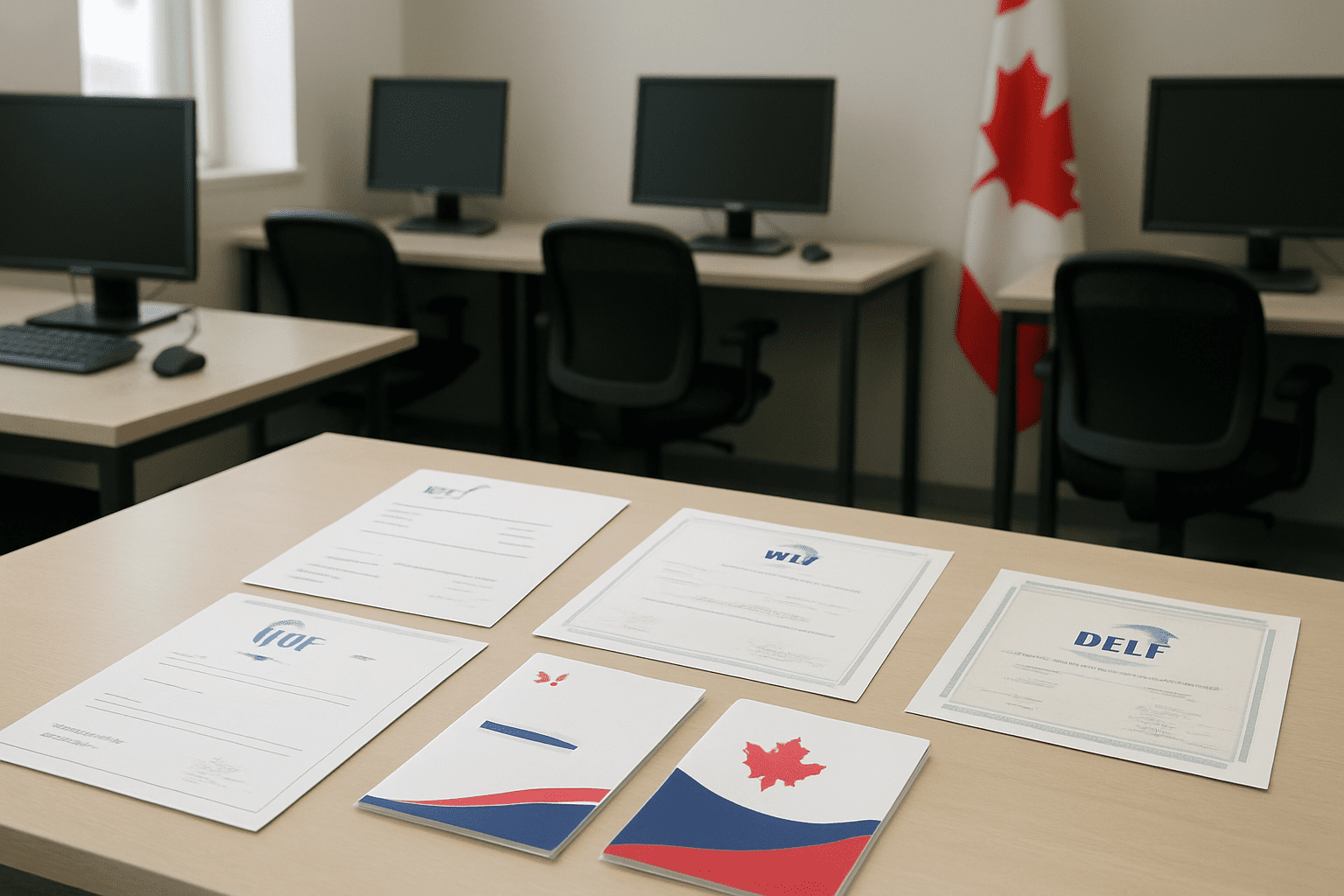
TEF Canada test format and scoring criteria
TEF Canada stands as one of the most recognized French proficiency tests for immigration purposes. The test evaluates four core language skills through distinct sections. Reading comprehension challenges test-takers with 50 multiple-choice questions completed within 60 minutes, covering various text types from simple instructions to complex articles. The listening section presents 60 questions over 40 minutes, featuring dialogues, announcements, and presentations that mirror real-life scenarios.
Writing skills get assessed through two tasks completed in 60 minutes: a structured argument essay and a practical writing exercise like drafting an email or report. Speaking evaluation involves 15 minutes of face-to-face interaction with an examiner, including guided conversation, role-playing scenarios, and expressing personal opinions on given topics.
The TEF Canada scoring system uses a scale from 0 to 450 points per skill. Immigration authorities convert these scores into Canadian Language Benchmarks (CLB) levels. Achieving 207-232 points equals CLB 4, while 280-309 points corresponds to CLB 7. Higher scores directly translate to more French language CRS points for your Express Entry profile.
TCF Canada examination structure and requirements
TCF Canada offers a computer-based testing experience with four mandatory sections. The listening comprehension segment contains 39 questions completed in 35 minutes, progressing from simple conversations to complex academic discussions. Reading comprehension features 39 questions within 60 minutes, testing understanding of various French texts including advertisements, articles, and literary excerpts.
The writing section requires completing three tasks in 60 minutes: correcting sentences, writing a personal narrative, and composing an argumentative text. Speaking assessment lasts 12 minutes and includes three exercises: answering personal questions, describing and comparing images, and defending a viewpoint on a given topic.
TCF Canada scoring ranges from 100 to 699 points per skill, with specific score ranges corresponding to different CLB levels. A score of 300-374 points typically equals CLB 4, while 450-498 points aligns with CLB 7. The computer-adaptive nature means question difficulty adjusts based on your performance, making accurate level assessment more precise.
Comparing test difficulty levels and preparation time
Both tests present unique challenges that affect preparation strategies. TEF Canada traditionally requires more intensive preparation time, typically 4-8 months for beginners reaching CLB 7 level. The test’s academic writing requirements and formal speaking scenarios demand structured learning approaches. Many candidates find TEF Canada’s listening section particularly challenging due to varied accents and speaking speeds.
TCF Canada generally requires 3-6 months preparation time for similar proficiency gains. The computer-adaptive format means questions adjust to your skill level, potentially creating a more manageable testing experience. However, the time constraints can be more pressing, especially in the speaking section where responses must be immediate and well-structured.
| Aspect | TEF Canada | TCF Canada |
|---|---|---|
| Preparation time (CLB 7) | 4-8 months | 3-6 months |
| Test difficulty | High (academic focus) | Moderate (adaptive) |
| Speaking format | Face-to-face | Computer-recorded |
| Writing complexity | Formal academic style | Mixed practical/academic |
Choosing the right test based on your current skill level
Your current French proficiency level significantly influences which test will help you boost CRS score French more effectively. Complete beginners (A1-A2 level) often find TCF Canada more approachable due to its adaptive questioning system. The computer format allows nervous test-takers to feel less intimidated without examiner pressure during speaking sections.
Intermediate learners (B1-B2 level) might benefit from TEF Canada’s structured approach, especially if they have academic French backgrounds. The face-to-face speaking component can actually work in favor of candidates comfortable with direct interaction, allowing for clarification and more natural conversation flow.
Advanced learners aiming to increase Express Entry points through high CLB levels should consider their strongest skills. TEF Canada rewards well-developed academic writing abilities and formal speaking confidence. TCF Canada favors test-takers who perform well under time pressure and adapt quickly to varying question difficulties.
Consider your learning timeline when choosing between tests. If you need results within 3-4 months for an upcoming Express Entry draw, TCF Canada’s shorter preparation period might be more realistic. For those with 6+ months available, TEF Canada’s comprehensive approach could yield higher scores and more Canada PR French test points for your immigration application.
Strategic Planning for French Language Learning

Assessing Your Current French Knowledge Level
Before diving into French language preparation, you need an honest evaluation of where you stand. Start with a free online placement test from reputable sources like TV5Monde or Alliance Française. These tests cover all four language skills and give you a baseline CEFR level.
Consider taking a mock TEF Canada exam to understand the test format and identify your strengths and weaknesses. Many candidates overestimate their speaking abilities while underestimating their writing skills. Document your current scores in each section – this becomes your starting point for tracking progress.
If you’ve studied French before, gather your old certificates or transcripts. Even high school French can provide a foundation, though you’ll likely need significant refresher work to reach the levels needed to boost CRS score French effectively.
Setting Realistic Timelines for Achieving Target Scores
Your timeline depends heavily on your starting level and target CRS points. Complete beginners typically need 12-18 months to reach B2 level across all skills, while those with some French background might achieve this in 6-12 months with dedicated study.
Break down your journey into phases:
- Phase 1 (Months 1-3): Foundation building and basic communication
- Phase 2 (Months 4-8): Intermediate skills development and test familiarity
- Phase 3 (Months 9-12): Advanced preparation and mock testing
Account for plateaus and setbacks – language learning isn’t linear. Build buffer time into your schedule, especially if you’re also preparing for English tests or other PR requirements. Most successful candidates plan for at least two test attempts to achieve their target scores.
Identifying Specific Language Skills That Yield Highest CRS Points
The CRS system awards different points for each language skill level, making strategic focus crucial for maximizing your French language CRS points. Here’s the breakdown for second official language (French):
| CEFR Level | Speaking/Listening | Reading/Writing | Total Points |
|---|---|---|---|
| B2-C1 | 6 points each | 6 points each | 24 points |
| B1 | 1 point each | 1 point each | 4 points |
Getting all four skills to B2 level gives you the maximum 24 points – a game-changer for your Express Entry points. Focus your energy on reaching B2 in all skills rather than pushing one skill to C1 while others lag behind.
Speaking and listening often progress together through conversation practice, while reading and writing require separate focused attention. Many test-takers find listening most challenging due to Quebec French accents in TEF Canada, so allocate extra time for audio comprehension.
Creating a Personalized Study Schedule for Maximum Efficiency
Design your study schedule around your learning style and daily routine. Most successful candidates dedicate 1-2 hours daily to French study, with longer sessions on weekends for practice tests and intensive skills work.
Structure your weekly schedule like this:
- Monday/Wednesday/Friday: Grammar and vocabulary building (45 minutes)
- Tuesday/Thursday: Listening practice with podcasts or videos (30 minutes)
- Daily: Speaking practice with language exchange partners (15 minutes)
- Saturday: Reading comprehension and writing practice (2 hours)
- Sunday: Mock test sections and review (1.5 hours)
Track your progress weekly using a language learning app or journal. Set monthly milestones – for example, completing a grammar level or achieving a specific score on practice tests. This keeps you motivated and helps identify when you need to adjust your approach.
Remember that consistency beats intensity. Thirty minutes daily outperforms three-hour weekend cramming sessions. Your brain needs regular exposure to build the neural pathways required for fluent French communication that translates to higher Canada PR French test scores.
Effective French Learning Methods for CRS Success

Online courses and platforms specifically for TEF/TCF preparation
Getting your hands on the right prep materials makes all the difference when you’re trying to boost CRS score French points. Several specialized platforms focus specifically on TEF Canada and TCF preparation, giving you targeted practice that mirrors the actual test format.
Prepmyfuture stands out as a comprehensive TEF Canada preparation platform, offering structured courses that align perfectly with the test’s four components. Their interactive exercises and mock tests simulate real exam conditions, helping you understand exactly what to expect.
Campus Langues provides both online and hybrid TEF preparation programs with experienced instructors who understand the nuances of Canadian French requirements. Their courses include personalized feedback sessions that help identify your weak areas.
For TCF preparation, TV5Monde offers free resources including practice exercises and sample tests. While basic, these materials give you a solid foundation before investing in premium courses.
Lingoda combines structured lessons with flexible scheduling, perfect for working professionals. Their French courses can be tailored to focus on TEF/TCF specific skills, and you’ll get plenty of speaking practice with native speakers.
| Platform | Focus | Price Range | Key Features |
|---|---|---|---|
| Prepmyfuture | TEF Canada | $200-400 | Mock tests, progress tracking |
| Campus Langues | TEF/TCF | $300-600 | Live instruction, feedback |
| TV5Monde | TCF | Free-$50 | Basic practice, cultural content |
| Lingoda | General + Test Prep | $100-300/month | Native speakers, flexible schedule |
Immersion techniques to accelerate language acquisition
Creating a French bubble around yourself speeds up your learning process dramatically. You don’t need to move to Quebec to get immersion benefits – you can build your own French environment right where you are.
Start by switching your phone, computer, and streaming services to French. This constant exposure helps your brain adapt to French patterns naturally. Watch French Canadian content specifically – series like “19-2” or “District 31” give you authentic Quebec French that’s directly relevant for your Canada PR French test.
Join local French conversation groups or online communities like HelloTalk and Tandem, where you can practice with native speakers. Many Canadian French speakers are happy to help newcomers, especially when they understand you’re working toward immigration.
Set up a daily French routine: morning news in French (Radio-Canada is perfect), French podcasts during commutes, and French audiobooks before bed. This creates multiple touchpoints throughout your day without requiring extra time.
Practice thinking in French by narrating your daily activities. When cooking dinner, describe what you’re doing in French. This builds the mental pathways needed for spontaneous French language CRS points during speaking tests.
Create French-only zones in your home or specific times when you only speak French. Even 30 minutes daily of French-only time builds confidence and fluency faster than traditional study methods.
Practice strategies for speaking and listening components
Speaking and listening components often trip up test-takers because they require real-time processing. The key lies in building your confidence through structured practice that mirrors test conditions.
Record yourself daily answering TEF Canada speaking prompts. Start with 1-minute responses and gradually build to the full 3-4 minutes required. Listen back to identify filler words, hesitations, and pronunciation issues. This self-assessment approach helps you catch problems before test day.
Use shadowing techniques with French audio materials. Play French content and try to repeat everything you hear simultaneously. This builds your ear for French rhythm and pronunciation while improving your speaking fluency.
For listening practice, start with slower content like news broadcasts, then progress to natural conversation speeds. French Canadian podcasts like “Pénélope” or “Les Chemins de traverse” offer authentic listening practice with various accents and speaking speeds.
Practice active listening by summarizing what you’ve heard immediately after each audio segment. This skill directly translates to the TEF/TCF listening sections where you need to identify main ideas and specific details.
Set up mock interview sessions with French-speaking partners or tutors. Practice common TEF speaking topics like describing experiences, expressing opinions, and problem-solving scenarios. The more comfortable you become with spontaneous French conversation, the better your increase Express Entry points potential.
Writing and reading skill development for test success
Writing strong French essays and comprehending complex texts requires systematic skill building. Focus on the specific formats and question types you’ll encounter on test day.
For writing preparation, master the essential French essay structures: argumentative, descriptive, and narrative formats. Practice writing 250-word responses within time limits, focusing on clear thesis statements, logical paragraph progression, and strong conclusions.
Build your French vocabulary systematically by learning word families rather than individual words. For example, learn “écrire” along with “écriture,” “écrivain,” and “scripteur.” This approach gives you multiple ways to express similar ideas during writing tasks.
Reading comprehension improves through daily practice with varied text types. Start with French Canadian newspapers like Le Devoir or La Presse, then progress to academic articles and literary excerpts similar to test materials.
Develop skimming and scanning techniques by practicing with timed reading exercises. Learn to identify main ideas quickly and locate specific information without reading every word. This skill saves precious time during actual tests.
Create vocabulary logs organized by themes relevant to immigration and Canadian life: employment, healthcare, education, and social issues. This targeted approach ensures you’re prepared for topics commonly featured in TEF Canada and TCF tests.
Practice summarizing French texts in your own words, both orally and in writing. This exercise strengthens both comprehension and expression skills while building the confidence needed to maximize your French language CRS points on test day.
Maximizing CRS Points Through Strategic French Score Targets

Minimum French scores needed for meaningful CRS boost
Getting the right French scores can seriously change your Express Entry ranking. You need CLB 7 (equivalent to TEF Canada 310-348 points in speaking/listening, 310-348 in reading/writing) to start earning French language CRS points. This threshold gets you an additional 25-28 points depending on your English proficiency level.
Reaching CLB 9 level really makes a difference – you can gain up to 50 additional points when combined with strong English scores. For TEF Canada, this means hitting 393-415 points in speaking and listening, plus 393-415 in reading and writing. The jump from CLB 7 to CLB 9 often provides the biggest return on your study investment.
Here’s what different French proficiency levels can add to your score:
| French Level | Additional CRS Points | TEF Canada Score Range |
|---|---|---|
| CLB 4-6 | 0 points | Below 310 |
| CLB 7 | 25-28 points | 310-348 |
| CLB 8 | 31-34 points | 349-392 |
| CLB 9+ | 46-50 points | 393+ |
Balancing study effort with potential point gains
Smart candidates calculate their time investment versus point rewards. If you’re sitting at 440 CRS points and need to reach 470+, those 30-50 French points could be your fastest route compared to other options like getting more work experience or pursuing additional education.
Consider your current situation: someone with intermediate French knowledge might reach CLB 7 in 4-6 months of focused study, while starting from zero typically requires 8-12 months to achieve meaningful scores. The key is being realistic about your timeline and the draws you’re targeting.
Study intensity matters too. Dedicating 10-15 hours weekly to French learning usually yields better results than cramming 30 hours in one week. Consistency beats intensity when building language skills for boost CRS score French strategies.
Combining French proficiency with other CRS factors for optimal results
The real magic happens when you stack French points with other CRS improvements. Candidates with strong English scores (CLB 9+) get maximum benefit from French learning because bilingual points multiply your language advantages.
Provincial Nominee Programs (PNPs) often favor French speakers, especially in Ontario, New Brunswick, and Manitoba. Getting nominated adds 600 points to your profile, making French proficiency a double win – direct CRS points plus PNP eligibility.
Work experience timing also plays a role. If you’re approaching three years of work experience (which maxes out work experience points), focusing on French during that period creates a strategic advantage. You’re not sacrificing other point opportunities while building language skills.
Education credentials assessment timing works similarly. While waiting for credential recognition, use that time for French preparation. This approach maximizes your increase Express Entry points without extending your overall timeline to permanent residency.

Learning French can be a game-changer for your Canadian immigration dreams. The CRS system rewards bilingual candidates with significant bonus points, and achieving even basic French proficiency can push your score well above the typical invitation thresholds. With accepted tests like TEF Canada and TCF Canada, you have clear pathways to demonstrate your French skills to IRCC. The key is smart planning and choosing the right learning approach for your timeline and goals. You don’t need to become fluent overnight – even moderate French scores can add 25-50 points to your CRS total. Set realistic score targets, pick learning methods that fit your schedule, and remember that every point counts in the competitive Express Entry pool. Ready to boost your CRS score and fast-track your Canada PR journey? Vrinda PrepMaster offers comprehensive preparation for French language tests including TEF Canada and TCF Canada. With expert guidance, structured learning modules, and proven strategies, PrepMaster helps you achieve the scores you need to maximize your CRS points. Don’t let language barriers hold back your immigration dreams – start your French learning journey with Vrinda PrepMaster today and watch your Canadian PR prospects transform.