
Starting your French learning journey feels exciting, but you’re probably wondering: how long does it take to learn French for beginners? The answer isn’t as straightforward as you might hope.
This guide is for absolute beginners who want realistic expectations about their French learning timeline. Whether you’re planning a trip to France, advancing your career, or simply love the language, knowing what to expect helps you stay motivated and make smart choices about your study approach.
The Foreign Service Institute estimates that English speakers need 600-750 hours to reach professional working proficiency in French. That sounds like a lot, but French is actually one of the easier languages for English speakers to master. Your personal timeline will depend on factors like your study method, previous language experience, and daily practice commitment.
We’ll cover the different French proficiency levels and what “fluency” actually means in practical terms. You’ll also discover the key factors that can speed up or slow down your progress, plus get a clear picture of what your first 100 hours of French practice should include. Finally, we’ll reveal common mistakes that waste precious study time and share strategies to make your learning more efficient.
Understanding French Proficiency Levels and What Fluency Really Means
Realistic Time Investment Required to Learn French
FSI Classification: Why French is Easier for English Speakers
The Foreign Service Institute classifies French as a Category I language, requiring 600-750 class hours for English speakers to reach professional working proficiency (S-3/R-3 level). This classification places French among the easiest languages for English speakers due to shared vocabulary—approximately one-third of English words have French origins dating back to the Norman invasion of 1066, providing learners with thousands of cognates as a foundation for faster acquisition.
Hours Needed for Each CEFR Level (80-1000+ Hours)
| CEFR Level | Estimated Hours | FSI Category |
|---|---|---|
| A1-A2 (Beginner) | 80-200 hours | Category I foundation |
| B1 (Intermediate) | 350-400 hours | Category I progression |
| B2 (Upper-Intermediate) | 500-600 hours | Approaching FSI target |
| C1-C2 (Advanced/Proficient) | 700-1000+ hours | FSI S-3/R-3 and beyond |
The FSI data shows French requires 30 weeks of intensive study (690 class hours) to reach professional working proficiency, which corresponds roughly to B2/C1 level in the Common European Framework.
Converting Study Hours into Months and Years of Learning
Based on different study intensities, here’s how FSI’s 600-750 hour requirement translates into realistic timeframes:
| Study Intensity | Hours per Week | Time to Reach 750 Hours |
|---|---|---|
| Casual learner | 3-5 hours | 3-5 years |
| Dedicated hobbyist | 8-10 hours | 1.5-2 years |
| Serious student | 15-20 hours | 9-12 months |
| Intensive program | 25+ hours | 6-8 months |
The FSI intensive program assumes 23 hours of classroom instruction plus 17 hours of self-study weekly, totaling 40 hours per week—a pace most independent learners cannot maintain long-term.
Why 600-750 Hours Gets You to Professional Working Proficiency
The FSI’s 600-750 hour benchmark represents the time needed to reach S-3/R-3 proficiency, defined as the ability to speak accurately on professional topics and read complex texts with full comprehension. This level corresponds to B2/C1 on the CEFR scale, where learners can participate effectively in professional environments, handle complex discussions, and understand nuanced written materials—making it the minimum standard for diplomatic and international business contexts.
Key Factors That Accelerate or Slow Down Your French Learning
Your Native Language Background and Previous Language Experience
Your linguistic foundation significantly impacts French learning speed. English speakers have a tremendous advantage since approximately 30% of English vocabulary derives from French, making words like “restaurant,” “police,” and “attention” immediately recognizable. If you speak Romance languages like Spanish, Italian, or Portuguese, you’ll benefit from even greater vocabulary and grammatical structure overlap. Previous language learning experience accelerates acquisition regardless of the specific language, as your brain develops enhanced pattern recognition abilities and you’ve already mastered efficient learning strategies.
The Power of Consistency vs Marathon Study Sessions
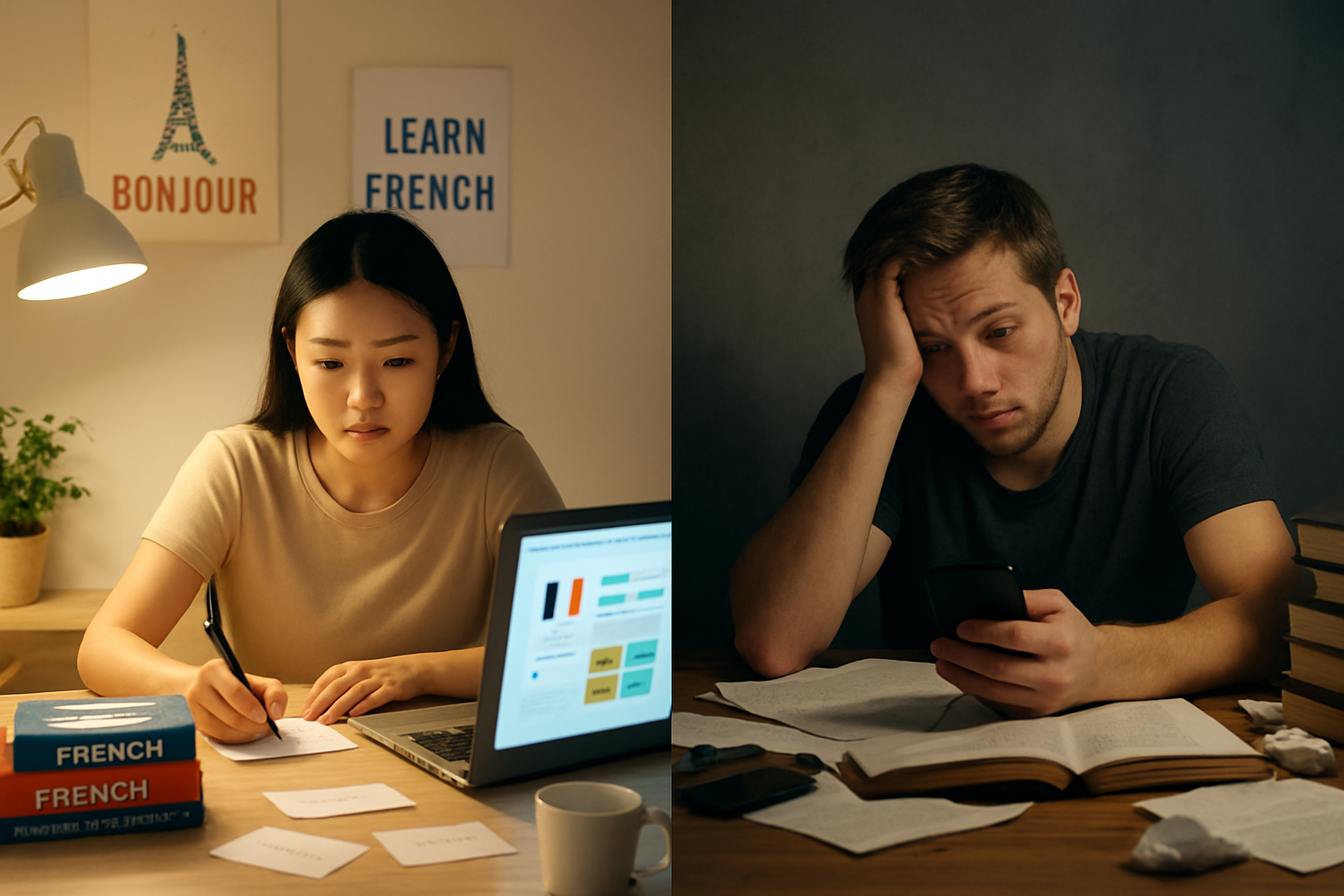
Daily consistency dramatically outperforms intensive cramming sessions for French acquisition. Thirty minutes of focused daily practice proves more effective than three-hour weekend marathons because your brain requires regular exposure to build neural pathways. The reference content emphasizes that consistent daily engagement allows for better retention and natural progression through proficiency levels, while sporadic intensive sessions often lead to burnout without proportional gains in language competency.
Creating Immersion at Home vs Living in French-Speaking Countries
Living in French-speaking countries can cut your learning timeline in half through constant input and speaking opportunities. However, you can create effective partial immersion at home by changing your phone settings to French, consuming French media content, and engaging with francophone communities online. Even simple environmental changes like switching social media to French provide hundreds of additional practice moments weekly, significantly accelerating your progression through CEFR levels without requiring relocation.
Quality Learning Materials and Structured Course Selection
Effective French learning requires diverse, high-quality resources rather than relying on single methods. The most successful approach combines structured courses with varied content including reading, listening, speaking, and writing practice. Spaced repetition applications for vocabulary retention, coupled with engaging French content that matches your personal interests, creates sustainable learning momentum. Quality materials should provide immediate application opportunities for newly learned grammar concepts rather than extended theoretical study.
Personal Motivation and Clear Goal Setting
Clear goal setting and sustained motivation directly influence learning speed and success. Targeting specific CEFR levels provides measurable milestones, with B2 representing functional fluency for most learners. Tracking progress through journals or monthly speaking recordings maintains motivation by demonstrating tangible improvement. Sustained commitment beyond mere class attendance, including dedicated practice time and content engagement, distinguishes successful learners from those who plateau at intermediate levels.
What Your First 100 Hours of French Practice Should Include
Building Essential Foundation Skills and Basic Vocabulary
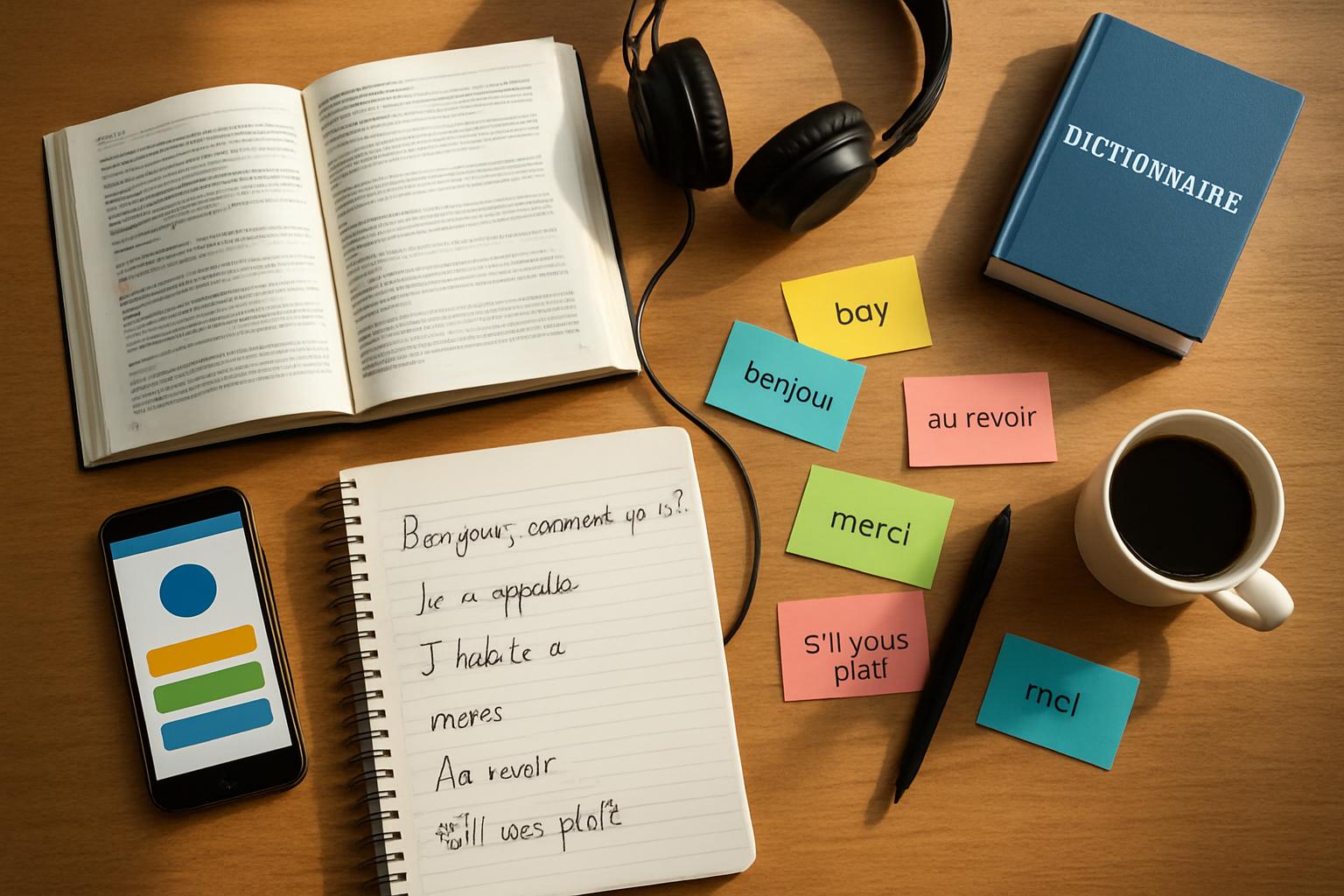
Your first 100 hours should prioritize the French alphabet, numbers 1-100, and essential subject pronouns (je, tu, il/elle, nous, vous, ils/elles). Master common greetings and basic vocabulary for days, months, colors, family members, and house-related words. Learn definite articles (le, la, les) and indefinite articles (un, une, des) early, as you’ll use these foundational elements constantly throughout your French journey.
Mastering French Pronunciation and Sound System Early
Focus on memorizing the French alphabet through song, as demonstrated in resources like Kylie Hicken’s pronunciation videos. This foundational step is crucial since you can’t progress effectively without proper letter pronunciation. Utilize audio resources from platforms like BBC and Forvo to practice authentic French sounds, ensuring you develop correct pronunciation habits from the beginning rather than correcting bad habits later.
Understanding Basic Grammar Structure and Sentence Patterns
Begin with conjugating the two most important verbs: être (to be) and avoir (to have), which form the foundation for almost every common expression and past tense construction. Progress through regular verb groups systematically: start with -er verbs (90% of French verbs), then move to -ir and -re verbs. Learn basic sentence structures for asking questions and forming negatives during this initial phase.
Daily Practice Routines That Build Strong Habits
Dedicate time each day to specific skills: memorize three weather vocabulary words daily, practice verb conjugations with tools like Reverso Conjugation, and use interactive platforms like Quizlet for vocabulary retention through flashcards and games. Incorporate telling time practice using the formula “Il est ___ heure(s) ___” and gradually build conversational skills with basic greetings before advancing to more complex topics.
Common Mistakes That Waste Time and How to Avoid Them

Gender Confusion and Article Agreement Errors
Every French noun carries either masculine or feminine gender, determining which article and adjective forms to use. Beginners often assume these choices follow logical patterns, but they’re frequently arbitrary. The most effective strategy involves memorizing nouns with their articles from day one, as saying “le livre” (the book) versus “la table” (the table) requires understanding this fundamental distinction. Additionally, adjectives must agree in both gender and number with their corresponding nouns, creating multiple agreement layers that English speakers typically overlook.
False Friends and Translation Traps
French contains numerous “faux-amis” (false friends) that appear identical to English words but carry completely different meanings. Common examples include “pain” meaning bread rather than discomfort, “location” referring to rent instead of place, “assister” meaning to attend rather than help, and “compétition” indicating tournament rather than general competition. These treacherous cognates affect approximately 60% of vocabulary due to shared Latin roots, making dictionary consultation essential when encountering familiar-looking words.
Word Order Differences Between French and English
French sentence structure creates frequent confusion through its distinct patterns for questions, negations, and adjective placement. Learners often incorrectly apply English word order, producing errors like “Je ne pas sais” instead of the correct “Je ne sais pas” (I don’t know). These structural differences require consistent practice in conversation-heavy environments where sentence patterns become naturally internalized through repetitive exposure and correction.
Skipping Pronunciation Practice and Grammar Fundamentals
Underestimating French pronunciation leads to significant communication barriers, as silent letters, nasal sounds, and the rolled “r” can create confusion between similar words like “verre” (glass) and “vert” (green). Similarly, overlooking verb conjugation fundamentals results in persistent subject-verb agreement errors. Regular listening to native speakers, combined with consistent oral practice and structured grammar instruction, prevents these foundational weaknesses from hindering overall language development.
Strategies to Maximize Your Learning Efficiency
The Importance of Regular Feedback and Error Correction
Now that we have covered the foundational time requirements for French learning, regular feedback becomes crucial for accelerating your progress. According to experienced language learners, the key is to embrace mistakes rather than fear them. When you encounter errors in your French, don’t immediately rush to correct every detail – instead, observe patterns and gradually internalize proper usage through continued exposure to authentic French content.
Balancing Structured Lessons with Real-Life Practice
With this foundation in mind, successful French learners combine formal study with immersive experiences. While structured lessons provide essential grammar frameworks and vocabulary building, real-life practice through French media, conversations, and authentic materials creates the contextual understanding necessary for fluency. The most effective approach involves using structured resources like grammar guides when curiosity arises, while prioritizing daily contact with compelling French content that matches your interests and current level.
Using French Media and Cultural Immersion Techniques
Previously mentioned structured approaches must be supplemented with rich cultural immersion. Digital immersion has revolutionized French learning – you can now access unlimited French content through YouTube channels like Français Authentique and innerFrench, Netflix shows, podcasts, and French news sources. Start with content that includes both audio and text, gradually progressing from simplified materials to authentic French media. Focus on topics that genuinely interest you, whether that’s French cinema, cooking, or current events, as passion-driven learning significantly improves retention and motivation.
When to Consider Professional Tutoring for Faster Progress
Moving forward in your French journey, professional tutoring becomes valuable when you need personalized feedback and structured conversation practice. Consider tutoring when you’ve established basic comprehension but struggle with spontaneous speaking, or when you need guidance navigating complex grammar patterns like the subjunctive or conditional tenses. A skilled tutor can provide the regular error correction and conversational practice that accelerates progress from intermediate to advanced levels, helping you transition from understanding French media to confidently participating in real conversations with native speakers.

Learning French as a beginner requires dedication and realistic expectations. With the FSI estimating 600-750 hours for professional working proficiency and most learners reaching functional fluency (B2 level) within 6-24 months of consistent effort, your timeline depends heavily on factors like your native language background, study consistency, and quality of materials. The CEFR framework provides clear milestones, from A1 beginner level (80-100 hours) to B2 functional fluency (500-600 hours), helping you track progress and set achievable goals.
Success in French learning comes from avoiding common pitfalls like neglecting pronunciation, irregular study habits, and direct translation from English. Instead, focus on consistent daily practice, proper pronunciation from the start, and thinking in French patterns rather than translating word-for-word. Whether you’re aiming for travel conversations or professional proficiency, remember that every milestone – from your first successful exchange to understanding French media – represents meaningful progress toward fluency.