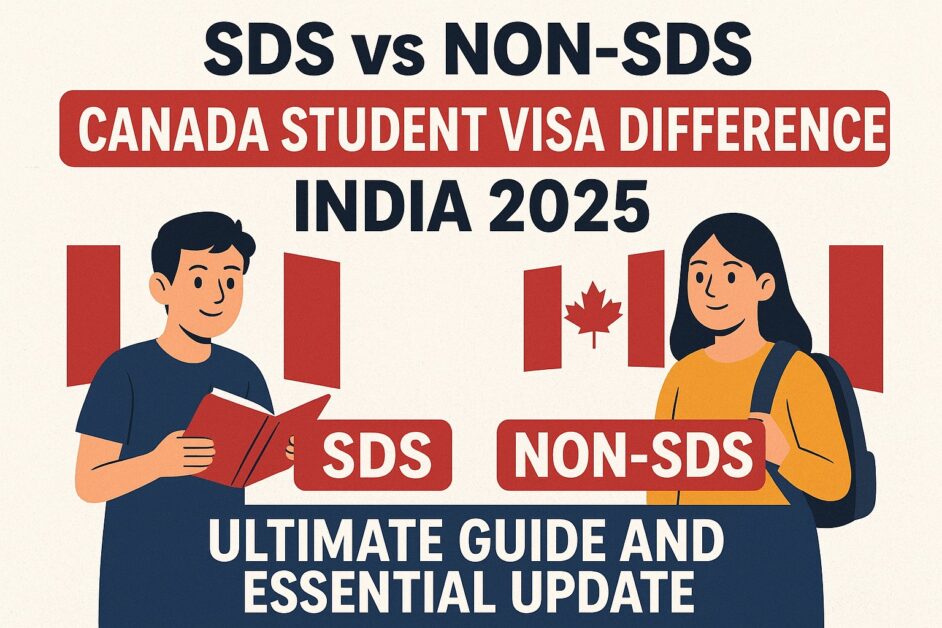
SDS vs Non-SDS Canada Student Visa Difference India 2025: IRCC closed the Student Direct Stream on November 8, 2024, so all Indian applicants now apply through the standard study permit route with updated funds and PAL rules in 2025.
This means the practical “difference” in 2025 is that SDS no longer exists, and previous SDS requirements like mandatory GIC and in-person language tests are historical rather than current.
What changed in 2025
IRCC ended the Student Direct Stream (SDS) effective November 8, 2024, moving all prospective students—including those from India—to the regular study permit process.
IRCC’s Studies page and public notices confirm the SDS closure and direct applicants to standard study-permit steps, eligibility, and processing-time tools.
SDS vs Non-SDS: Then vs now
Historically, SDS offered faster processing for eligible countries including India with conditions such as upfront GIC, first-year tuition payment, and specific in-person language tests at CLB 7 levels.
From late 2024 onward, SDS submissions are no longer accepted, so the only valid pathway in 2025 is the regular study permit application with the same financial rules applied to all applicants.
Financial requirements in 2024–2025
Between January 1, 2024 and August 31, 2025, IRCC requires living expenses of at least CAD 20,635 for a single applicant, excluding tuition and travel, which can be shown via proofs like tuition receipts, GIC, bank statements, or loans.
From September 1, 2025, news outlets reporting IRCC’s update indicate the single-applicant funds threshold increases to CAD 22,895, exclusive of tuition and travel, aligning with annual cost-of-living adjustments.
Processing times
IRCC no longer offers SDS priority, so applicants should check current country-specific timelines using the IRCC processing time tool.
Processing can vary widely depending on volume and case specifics, so planning with the latest IRCC timelines is essential in 2025.
Documents and eligibility
All study permit applicants must include standard documents such as a letter of acceptance from a DLI, proof of funds, identity documents, biometrics, and country-specific items as applicable.
IRCC’s “Study permit: Who can apply” and “Get the right documents” pages outline eligibility and document checklists, which apply to all in 2025.
PAL: Attestation Letter rule
IRCC introduced the Provincial Attestation Letter (PAL) requirement in 2024 for most post-secondary applicants, with specific exemptions and province-managed issuance.
IRCC’s study-permit portal also highlights PAL/TAL requirements and links to current processing and fee information.
What Indian applicants should do now
Given the SDS closure, Indian applicants should follow the regular study permit route, ensure funds meet the IRCC threshold, and include a PAL unless exempt.
Applicants should use IRCC’s main study-permit hub for up-to-date forms, fees, and timelines, and plan proof of funds in line with the latest thresholds and timing.
SDS vs Non-SDS Canada Student Visa Difference India 2025:
SDS vs Non-SDS Canada Student Visa Difference India 2025 appears in searches because many Indian students historically used SDS for faster processing, but IRCC has now closed SDS and moved all applications to the regular study permit pathway.
This policy shift emphasizes uniform access, integrity, and a single standard for funds and documentation across all international applicants in 2025.
Financials: what to budget now
IRCC requires applicants to demonstrate sufficient funds without work in Canada to cover living expenses, tuition, and travel, and publishes the annual living-expense thresholds used for assessments.
For applications between January 1, 2024 and August 31, 2025, the single-applicant living expense requirement is CAD 20,635 (excluding tuition and travel), with proportional increases for family members.
From September 1, 2025, reports indicate IRCC will lift the single-applicant threshold to CAD 22,895, so planning should reflect the submission date and updated benchmarks.
Processing: what to expect
With SDS closed, there is no dedicated fast lane, so applicants should consult IRCC’s live processing-time tool and apply early to manage intake cycles and volume variations.
The processing-time tool is regularly updated, and using it helps set realistic timelines for admission deferrals, fee payments, and travel planning.
Eligibility and documents: what remains key
The standard study permit requires a DLI offer of admission, identity documents, proof of funds, and biometrics where applicable, with additional visa-office instructions for local requirements.
IRCC’s eligibility page outlines who can apply and the general conditions for holding a study permit, which all applicants must meet in 2025.
PAL: the structure behind the cap
The Provincial Attestation Letter (PAL) is now central to the study permit process for most post-secondary categories, reflecting province-level allocations and capacity management.
Applicants exempt from PAL should confirm their category against current IRCC guidance before applying.
Action plan for Indian applicants
- Follow the regular study permit route, ensuring all documents match IRCC’s current checklist and country instructions.
- Align application timing and funds with the 2024–2025 thresholds, adjusting plans for the September 1, 2025 increase if applying on or after that date.
- Secure a PAL where required, coordinate with the institution, and verify exemptions if applicable.
FAQ’s
Is SDS available for Indian students in 2025?
No, IRCC ended the Student Direct Stream on November 8, 2024, and all new study permit applications must go through the standard process.
What is the required proof of funds for 2025?
For applications until August 31, 2025, the single-applicant living expense requirement is CAD 20,635 (tuition and travel extra), with a reported increase to CAD 22,895 from September 1, 2025.
Is a PAL required for Indian applicants?
Most post-secondary applicants require a PAL or TAL under IRCC’s 2024 changes, with limited exemptions defined on IRCC’s PAL page.
What replaced SDS benefits like faster processing?
There is no direct replacement; applicants should track standard processing times with IRCC’s tool and apply early with complete documentation.